

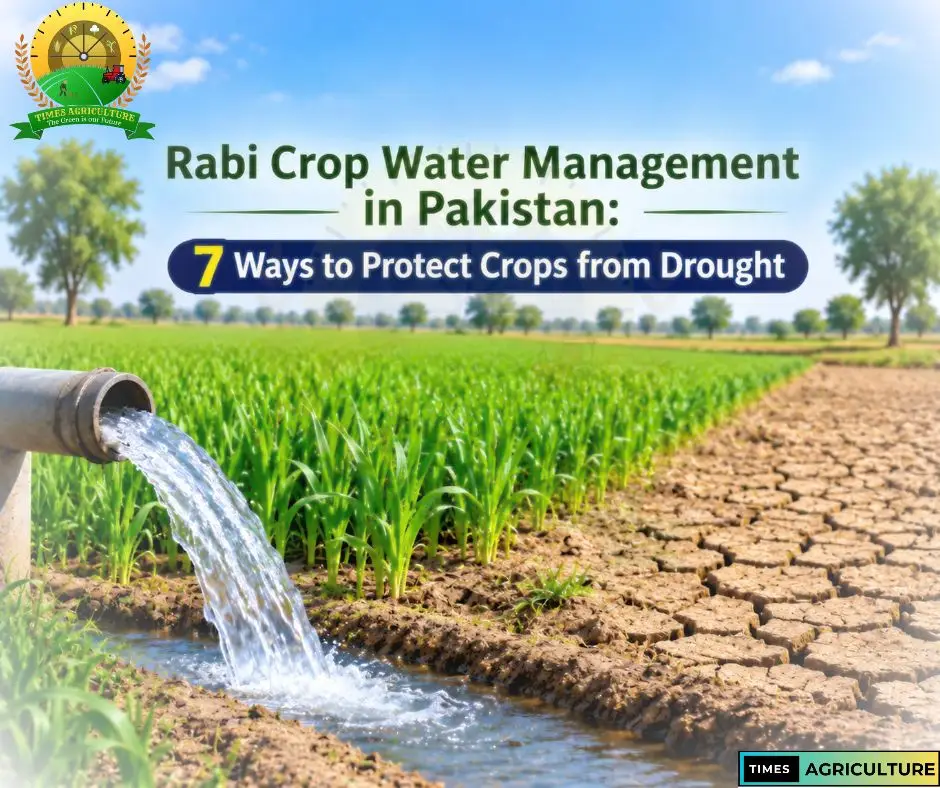
Rabi crop water management is becoming especially important in Pakistan’s Sindh, Balochistan and southern Punjab as the Pakistan Meteorological Department (PMD) warns that prolonged rainfall shortages could worsen drought conditions during the 2026–27 winter. PMD’s November 2026 Drought Watch is a precautionary advisory, not a declaration of a drought emergency, but it signals that farmers should protect soil moisture, plan irrigation around crop growth stages and monitor local forecasts rather than wait for visible crop stress.
A report published on 21 November 2026 described persistent rainfall deficits since July. Sindh recorded particularly severe monthly shortfalls, while Balochistan also remained below normal through the assessment period. Southern Punjab has vulnerable pockets even though other parts of the province received better rainfall. Conditions differ from district to district, so every farm needs a local water plan rather than a single province-wide irrigation schedule.
Why the warning matters during Rabi sowing
Rabi crops depend on a combination of stored soil moisture, irrigation water and winter precipitation. When the soil profile enters the season already dry, seed placement and germination can become uneven, seedlings may establish slowly, and later irrigation demand can rise. Rain-fed fields are especially exposed because they cannot replace a missed rainfall event with canal or groundwater supplies.
PMD’s October 2026 drought bulletin advised moisture conservation and efficient irrigation in southern dry areas, and said residual soil moisture could be used for Rabi land preparation. Its outlook also showed that rainfall prospects were not uniform: northern and upper regions were more likely to receive normal or above-normal rain, while parts of Sindh, southern Punjab and Balochistan were expected to remain relatively dry. Farmers should therefore follow district and tehsil forecasts as they are updated, not assume that a national outlook describes their own field.
1. Check the soil profile before deciding to irrigate
A dry-looking surface does not always mean the whole root zone is dry. Equally, a damp surface after a light shower may hide a dry layer below. Before spending money on pumping, inspect soil at several points in each management zone and at more than one depth. A soil auger, probe or spade can reveal whether moisture is present where young roots are developing.
- Check more than one representative spot, including lighter-textured rises and heavier low areas.
- Compare the topsoil with soil lower in the developing root zone; do not base the decision on the surface alone.
- Use the feel-and-appearance method as a practical field check, but learn how it behaves in your own soil texture.
- If available, use calibrated moisture sensors and record readings at consistent depths.
- Repeat checks after rainfall or irrigation to confirm that water has penetrated the intended root zone.
University of Minnesota Extension recommends regular soil-water monitoring and explains how soil moisture sensors and a weather-based water-balance method can guide irrigation decisions. The principle is straightforward: account for rainfall and irrigation entering the root zone, and crop water use leaving it. A short field record is more reliable than irrigating by habit.
2. Protect wheat at the stages when water matters most
For wheat, the first irrigation deserves particular attention. The Agriculture Department of Sindh states that, under normal optimum conditions, four to five irrigations may be sufficient and that the first should generally be given three to four weeks after sowing. It identifies crown-root initiation (CRI) as the most important irrigation stage for root development and nutrient uptake, with tillering, heading, milky and dough stages also important.
Those figures are a regional reference, not a fixed prescription for every field in a dry year. Soil texture, sowing date, variety, rainfall, field levelling, rooting depth and the amount of water actually available all affect timing and frequency. A sandy field may lose available moisture faster than a heavier soil; a field that received effective rain may not need the same irrigation as a nearby dry field.
Walk the crop and identify the growth stage instead of relying only on the calendar. If wheat was sown at different dates in separate fields, keep separate records. Where water is limited, ask the local agriculture extension officer which growth stages should receive priority under the current district conditions. Do not automatically cut the first irrigation or postpone it beyond the locally recommended CRI window.
3. Give pulses and other Rabi crops a crop-specific plan
Do not copy the wheat schedule for chickpea, lentil, mustard, barley or vegetables. Their rooting patterns, growth duration and sensitive stages differ. The Sindh Agriculture Department’s irrigation guidance, for example, describes a different approach for gram and lentil from the one it gives for wheat. It notes that gram benefits from adequate pre-sowing moisture and may need a post-sowing irrigation around pre-flowering depending on soil texture; lentil may need one irrigation at pre-flowering, with lighter soils sometimes requiring another.
These are broad local guidelines, not a substitute for checking the crop, soil and current water supply. Excess water can damage crops as much as a shortage for those sensitive to waterlogging. Before changing a crop plan or withholding irrigation, confirm the recommendation for the variety and district with a qualified local adviser.
4. Keep the soil covered where the cropping system allows
Bare, repeatedly cultivated soil loses surface moisture more quickly and is more exposed to wind and raindrop impact. Where it does not interfere with sowing, residue management or pest control, retain suitable crop residues as a surface cover. Avoid burning residues simply to clear a field. On suitable fields, a mulch layer can reduce direct evaporation, slow runoff and help more rainfall enter the soil.
The Food and Agriculture Organization’s conservation-agriculture guidance explains that organic soil cover helps shade the surface, reduce evaporation and improve water infiltration. The benefit depends on the amount and distribution of cover, soil type and local climate. Residue is not a universal solution: it must be managed so seed drills can operate, crop emergence is not obstructed and pests are not encouraged.
5. Reduce avoidable losses between the water source and the crop
When water is scarce, small losses add up. Inspect field channels, watercourses, gates, pipes and pump connections for leaks or damaged sections. Repair obvious defects before the next irrigation turn. Level fields where unevenness repeatedly leaves one section flooded while another remains dry. On sloping land, use field layouts and bunds suited to the soil and slope so water does not run off before it can infiltrate.
For vegetables, orchards and other high-value crops, well-designed drip or sprinkler systems may improve control, but only when the system is correctly sized, maintained and affordable. A poorly designed system can distribute water unevenly or create extra costs without solving the farm’s main constraint. Start by measuring how water is currently distributed and fixing the simplest losses.
6. Match fertilizer applications to moisture and crop demand
Fertilizer cannot compensate for a dry root zone. If nitrogen is applied when plants cannot take it up, the crop may not respond as expected and nutrients can be lost when water eventually arrives. Follow local fertilizer recommendations, split applications where advised, and coordinate top-dressing with a suitable irrigation or rainfall opportunity. Avoid increasing fertilizer rates in an attempt to force growth through water stress.
7. Watch for stress early, but diagnose the cause
Slow growth, rolled or dull leaves, poor tillering and uneven crop colour can indicate water stress, but they can also result from salinity, nutrient deficiency, root disease, compaction or uneven sowing. Compare affected patches with healthier areas and inspect roots and soil moisture before deciding what treatment is needed. If the pattern follows a saline patch, blocked channel or compacted wheel track, simply adding more water may not solve the problem.
A simple weekly water-planning routine
- Check the latest PMD forecast and local crop advisory for your district.
- Walk each field and record crop stage, visible stress and differences between soil zones.
- Check soil moisture below the surface at representative points.
- List available canal turns, well capacity, fuel or electricity cost, and any stored water.
- Prioritise irrigation according to crop stage and local recommendations, not habit.
- Inspect channels and irrigation equipment, then record how much water was applied and where it reached.
- Reassess after rain; do not apply a planned irrigation automatically if effective rainfall has changed the soil-water balance.
Plan for uncertainty, not a guaranteed drought
The PMD warning should prompt preparation, not panic. A seasonal outlook is not a field-level forecast, and rainfall can vary sharply over short distances. Keep checking updated advisories, protect the soil moisture already in the field, and use irrigation where it can protect the crop at a sensitive stage. Farmers in rain-fed districts should also discuss local contingency options with extension staff before making expensive changes to seed, fertilizer or pumping plans.
The strongest response to a dry winter is disciplined field-by-field management: measure moisture, protect critical crop stages, reduce avoidable losses and keep the soil covered where practical. Those steps will help farms use limited water more effectively whether the coming months turn out drier than expected or rainfall improves.