

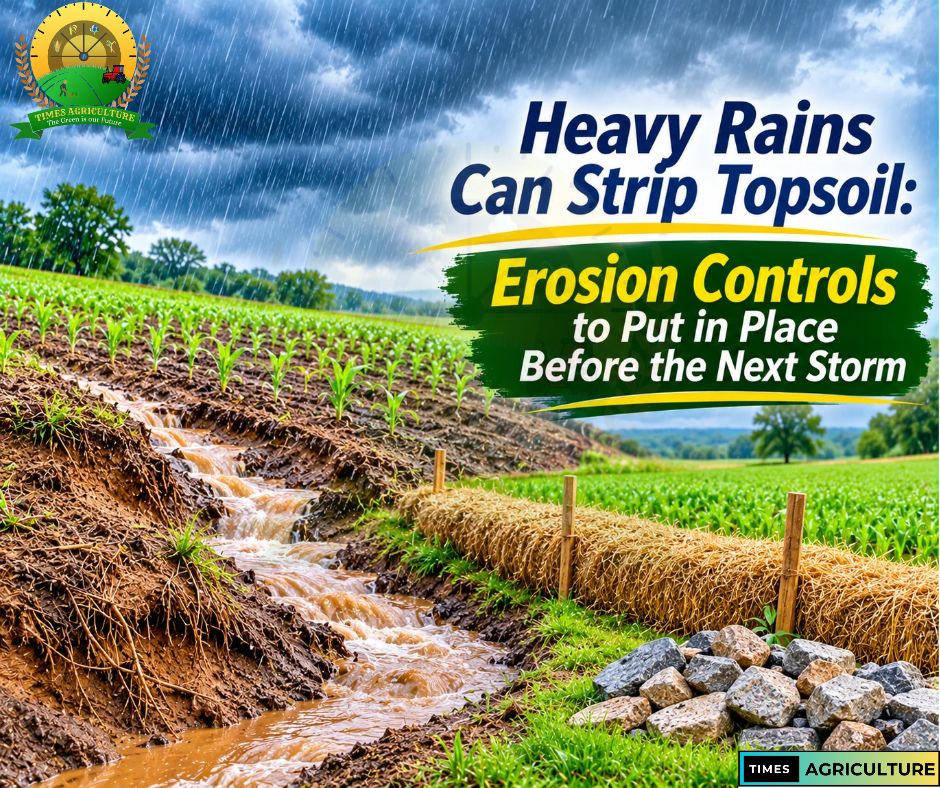
Heavy rain does more than delay fieldwork. When water runs across bare or freshly cultivated ground, it can carry away the fertile topsoil, seed, nutrients and recently applied fertiliser. A single storm can cut small channels into a slope; repeated runoff can turn those channels into gullies that are expensive to repair. Farmers in Kenya are responding to the current short-rains season with simple barriers and vegetation, but the same principles apply to sloping fields, orchards and vegetable plots in many parts of the world.
On November 17, 2026, the Associated Press reported on Kenyan growers using sand-filled sacks in shallow trenches, Napier grass and bamboo to slow runoff after earlier floods stripped topsoil from their farms. Kenya Meteorological Service’s monthly forecast, issued on October 30, expects above-average November rainfall across many counties, while also showing that rainfall prospects vary by location. The lesson is not that every farm should build the same barrier. It is that erosion control works best when growers identify where water enters, how it moves and where it can leave the field safely before the next heavy storm.
Why heavy rain removes so much valuable soil
Rainfall erosion begins when raindrops strike exposed soil and break aggregates apart. The loosened particles can block surface pores and reduce infiltration. If rainfall intensity exceeds the soil’s ability to absorb water, runoff begins. On a slope, that water gains speed and can transport sediment, organic matter, fertiliser and seed.
Damage often develops in stages:
- Sheet erosion: a thin layer of soil is removed across a broad area. It may be difficult to notice until crop growth becomes uneven or stones and roots become exposed.
- Rill erosion: runoff concentrates into small channels that can often be removed by normal cultivation, although the underlying cause still needs correcting.
- Gully erosion: channels deepen and widen until ordinary field operations cannot safely cross or repair them.
The loss is not limited to the soil that leaves the field. Erosion reduces the depth of productive topsoil, removes nutrients and organic matter, exposes less fertile subsoil and can deposit sediment in drains, ponds and streams. FAO explains that runoff management must be adapted to rainfall, soil, slope and the condition of the land; a practice that stores water safely in a dry region may cause waterlogging or damage if used without modification in a wet region.
Start with a field walk, not a machine
After a storm, walk the field when it is safe and the soil is firm enough to avoid causing further damage. Look for pale sediment fans, exposed roots, small channels, deposits behind fences, blocked drains and places where water enters from a road or neighbouring field. Note where runoff starts, where it gathers speed and where it leaves.
Mark the affected areas on a simple field sketch or phone map. Separate the field into upper slopes, mid-slope sections, lower areas and natural drainage lines. A short, concentrated flow path may need a different treatment from widespread sheet runoff. Also check whether livestock tracks, tractor wheelings, gateways or compacted headlands are directing water into one channel.
Do not cultivate saturated soil simply to close visible channels. Working wet ground can smear and compact it, reducing infiltration and making the next runoff event worse. Wait until the soil is fit to work, and use the delay to plan a safer water route.
Keep the soil covered between crops
Vegetation and crop residues protect the soil surface from the direct impact of raindrops. A cover crop, retained residue or suitable mulch also slows shallow runoff and gives water more time to enter the soil. FAO identifies soil cover as a core principle of conservation agriculture and notes that cover crops can protect fallow land, recycle nutrients and improve soil structure.
Choose a cover crop that fits the local growing season, water supply and following cash crop. Cereal rye, oats, triticale, clovers, vetches and locally adapted grasses are used in different regions, but no single species suits every climate. In a dry area, a cover crop that uses too much stored moisture may compete with the next crop. In a wet area, select species and termination dates that leave enough time for the following crop to establish.
Where a cover crop cannot be established in time, retain clean, disease-free crop residue as a surface mulch if local pest, disease and planting requirements allow it. Spread residues evenly rather than leaving thick piles that can interfere with seeding or create damp patches. Avoid burning residues simply to clear a field; consider chopping, baling or managed surface retention according to local agronomic advice.
Plant and cultivate across the slope
On suitable slopes, rows, beds and cultivation lines should follow the contour rather than run straight downhill. Contour farming interrupts the length of the slope and slows the movement of water. The US Environmental Protection Agency describes contour farming as a way to reduce runoff velocity and give more time for infiltration.
Farmers can identify contour lines using a surveyor’s level, laser level or a simple A-frame level where appropriate. Mark the line carefully before planting. Rows that drift downhill can unintentionally become channels, so check alignment during field preparation and repair breaks in ridges before heavy rain.
Contour cultivation is not a universal fix. On very steep or irregular land, poorly designed ridges can concentrate water and fail. Where slopes are steep, soils are unstable or runoff volumes are large, ask an agricultural engineer or soil-conservation specialist to plan the system rather than improvising earthworks.
Use grass strips to slow and filter runoff
Permanent strips of grass or other dense vegetation can be placed across a slope, along field boundaries or beside drainage routes. Their stems slow flowing water and trap some of the sediment it carries. Deep, fibrous roots help bind the soil. The width, spacing and species depend on slope, soil, rainfall and the amount of runoff; local extension services can recommend suitable grasses or shrubs.
In Kenya, the AP report described farmers planting Napier grass and bamboo in vulnerable areas. Napier can also provide livestock fodder, making it useful where it is locally suitable and managed so it does not become invasive or compete with the main crop. Bamboo is not appropriate for every site: species, spread, water demand and management need to be considered before planting it near drains, streams or field boundaries.
Do not plant a vegetative strip in a way that blocks a natural watercourse or pushes floodwater onto a neighbour’s land. Keep a safe, stable route for excess water and maintain the vegetation so gaps do not form.
Protect drainage lines and repair small channels early
Water should leave the farm without cutting through productive soil. Grassed waterways can carry concentrated runoff along a stable, vegetated channel. Keep these routes free of rubbish, sediment piles and machinery damage. Avoid driving along the channel when the soil is wet.
For small, shallow rills, repair may be possible once the soil is dry enough to work. Regrade the surface gently, restore cover and correct the source of concentrated flow. A few stones, brushwood or properly placed sandbags can slow water at a small erosion point, as the Kenyan farmers in the AP report have demonstrated. Such barriers are temporary measures, not substitutes for a designed drainage system.
Do not build a solid obstruction across a large drain or stream. A barrier that holds back too much water can fail suddenly, sending a destructive surge downstream. Gabions, check dams, diversion channels and large terraces need proper design, safe outlets and maintenance. Seek local technical advice before installing them, especially above homes, roads, livestock areas or neighbouring fields.
Reduce compaction and avoid exposing wet soil
Compacted headlands, gateways and wheel tracks often become runoff pathways. Reduce unnecessary machinery passes, avoid heavy traffic when soil is wet and use permanent traffic lanes where the farm layout allows. Maintain organic matter and root activity to support stable soil structure over time.
Where a field is bare after harvest, plan the next crop or cover before the rainy period begins. On sloping land, avoid leaving long, uninterrupted strips of finely tilled soil exposed. Strip cropping can alternate erosion-prone row crops with close-growing crops or grass strips. The arrangement should follow the contour and be adapted to the slope and machinery width.
Match crop and harvest decisions to the forecast
Weather forecasts are useful only when they change a farm decision. Check local daily and weekly forecasts as well as seasonal outlooks. A seasonal forecast indicates probabilities over a broad area; it does not tell a grower exactly when rain will fall on one field. Kenya’s November 2026 outlook, for example, identifies many counties with above-average rainfall prospects but also describes regional differences. Farmers should use county-level updates rather than assume conditions are uniform.
Where prolonged heavy rain is likely, consider whether planting can be delayed safely, whether a more water-tolerant crop or variety is suitable, and whether field access will be possible at harvest. The AP report notes advice from a Kenyan agronomist to adjust planting schedules for crops such as beans, potatoes and cabbage where prolonged wet conditions could cause damage. Crop choice must still reflect local markets, soil drainage, variety and the full seasonal forecast.
Protect harvested grain as well as the field. Wet maize held in heaps, trailers or poorly ventilated stores can develop mould and aflatoxin. FAO guidance identifies rapid drying and safe storage moisture as central controls. Use a calibrated moisture meter where possible, dry grain promptly using a locally recommended method, keep it off wet floors and protect it from re-wetting. The correct storage target depends on temperature, storage duration and local standards; do not rely on touch or appearance alone.
A practical erosion-control checklist
- Before the next storm: inspect slopes, mark runoff paths, clear safe drainage outlets and protect bare soil with suitable residue or vegetation.
- During field preparation: avoid working saturated soil, align suitable rows on the contour and prevent wheel tracks from becoming channels.
- Along the slope: maintain grass strips, repair gaps and keep livestock from trampling vulnerable banks.
- At drainage points: stabilise small rills early, keep waterways clear and obtain technical advice for terraces, gabions or large diversion structures.
- At harvest: plan machinery access, move wet grain promptly and dry it to the appropriate safe-storage moisture level.
- After heavy rain: record where soil moved, repair the cause rather than only filling the channel, and update the field plan.
What works best depends on the farm
On a gently sloping field, contour rows, residue cover and grassed waterways may provide a practical starting point. On a steep hillside, permanent vegetation, carefully designed terraces and professionally planned drainage may be needed. In a semi-arid area, the priority is often to slow runoff and store as much rainfall as the soil can safely absorb. In a humid region, the system must also prevent waterlogging and provide a safe outlet for excess water.
There is no single barrier that can protect every field. Combine surface cover, good soil structure, sensible traffic management and stable drainage. Start with the cheapest measures that address the actual flow path, then seek technical help where water is concentrated or the slope is steep.
Conclusion: save the soil before the storm arrives
Topsoil takes years to build and can be lost in a few intense storms. The Kenyan examples reported this week show how farmers are using local materials and perennial vegetation to reduce runoff, while official forecasts underline the value of preparing before rainfall peaks. Walk the field, keep soil covered, cultivate across suitable slopes, protect drainage lines and avoid unsafe earthworks. These steps will not prevent every flood, but they can reduce avoidable soil loss and help farms recover faster after heavy rain.
Times Agriculture: The Green is Our Future